

Leeds Independent Film History: Part One
Looking for the Origins of Independent Film Exhibition in Leeds
On a Sunday night in 1930, in a basement beneath a synagogue at the corner of Exmouth Street and Camp Road, an audience gathered to watch a silent film. It was technically illegal to open cinemas on Sundays, but a group of schoolboys had found a way around this prohibition by using a non-cinema space. A homemade screen had been erected, and music had been carefully prepared; these young enthusiasts were presenting the expressionist marvel, The Cabinet of Dr Caligari. This is where the origins of independent film exhibition in Leeds begin: with a small members-only club determined to show films that commercial cinemas would not.
One might assume this history begins earlier, with Louis Le Prince, the pioneering French inventor who captured the world’s first moving images here in Leeds. Yet Le Prince never exhibited his work publicly. Although a private demonstration is believed to have taken place for friends at his Woodhouse Lane studio in autumn 1888, his inventions remained largely unseen, and film exhibition developed in his absence. His work belongs to an important prehistory - one of invention, experiment and rivalry - rather than to the culture of independent film exhibition that would follow.
This history takes shape in the 1920s, as a new kind of film culture began to emerge: one made up of filmmakers, critics, and amateur enthusiasts. The origins of independent film exhibition in Britain are often attributed to the film society movement, with the first such society established in London in 1925. These societies championed film as a legitimate artistic medium worthy of study, and their rise coincided with the early development of film criticism and academic studies in Britain. They aimed to provide an alternative to the commercial film industry’s reliance on Hollywood productions, offering opportunities to see films that would otherwise remain unseen. Their rejection of Hollywood was intensified by a desire to access more international films, follow new trends in artistic filmmaking, and re-evaluate the aesthetic value of silent cinema. These early efforts were marked by a degree of elitism, with London’s society largely composed of its intelligentsia and focused on cultivating a small, members-only group of ‘discerning’ and ‘intellectual’ viewers. This model would soon be adapted and reworked beyond London, including in Leeds.
Tracing the origins of this alternative film culture in Leeds led me to the Alec Baron archive in the Special Collections at the University of Leeds. Through an archive of film programmes, flyers, periodicals, correspondence, personal writings, and press cuttings, Baron emerges as a key figure in the development of film exhibition in the city. Baron was a different kind of pioneer from Louis Le Prince. He did not invent moving images, but he helped shape the conditions in which they were seen, discussed and appreciated. Baron was involved in several film firsts, the earliest being the establishment of Leeds's first film society in 1930. Baron later played a role in bringing the first Repertory Cinema outside of London to Leeds. He was an active participant in the wider film society movement and built close links with the British Film Institute from its inception, initially through the Leeds Film Society Institute, and later with Leeds Film Theatre as part of the BFI’s Regional Film Theatre network.
Born in Leeds in 1913 to Russian Jewish parents who had fled the pogroms, Baron was the youngest of four siblings. His earliest encounters with cinema involved taking his mother to their local picture house and reading the intertitles aloud to her. As a young man, Baron aspired to become a film director, but he set those ambitions aside when he remained at home to help with the family tailoring business. Instead, he found other ways to pursue his interest in film. Alongside a group of like-minded collaborators, he co-founded the Leeds Jewish Film Society, an amateur filmmaking club that provided an outlet for his creative energies. Several of his films survive today in the Yorkshire Film Archive, and you can view some of them via their website here.
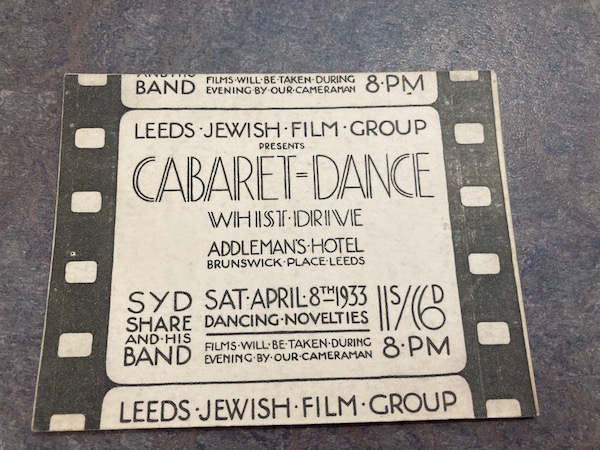
Leeds Jewish Film Group Cabaret and Dance Invitation Card, 1933
(Alec Baron Archive, University of Leeds Special Collections)
Beyond film, Baron’s other main passion was theatre, and there is an equally substantial collection of material in the Special Collections related to Baron’s theatrical pursuits. Active in both amateur and professional theatre communities in Leeds, Baron wrote and directed numerous plays, was a founding member of Leeds Unity Theatre (inspired by the leftist Unity Theatre in London), and later the Proscenium Players, the first Jewish Amateur Stage Group in Leeds. Baron contributed to the creation of Leeds Playhouse, leaving the family business to become its first Administrator, and later wrote television screenplays, including for Coronation Street and The Two Ronnies. He was deeply involved in the city’s cultural life and an important contributor to it.
In 1930, Baron and a group of school friends formed what would become Leeds’s first film society: the Leeds Film Group. Their shared love of the arts coalesced some years earlier, when they created a secret club, the ‘Dramatic and Arts Club’. Eight boys met after school in one another’s living rooms to discuss what they had read or seen, sometimes inviting outside speakers. This informal arts club lasted several years before film emerged as its primary focus. In his unpublished memoir, Baron described their growing fascination with film:
"Three of us, Leonard Rosenthal, Gersh Crawford and myself, had become very interested in the cinema as an art-form and had studied it closely, particularly under the influence of Paul Rotha’s remarkable book THE FILM TILL NOW, which Leonard and I had each bought with money we won in a newspaper “Spot the Stars” competition in which film actors had to be identified from a shot of the back of their left ear or in a strange make-up. This was the first book which discussed cinema as an art form rather than as entertainment."
Paul Rotha was a significant figure in the British documentary film movement, alongside John Grierson and Basil Wright. Rotha’s early critical writings on film (especially The Film Till Now) would prove influential to the film society movement, early independent exhibitors, and art-minded cinema-goers, serving as a guidebook for these young film enthusiasts. Rotha was also a vocal advocate for alternative film exhibition, campaigning for a dedicated art cinema in London through an organisation called the ‘Film Group’ (a name that finds echo in Leeds).
Along with Rotha’s foundational writings on film, Baron and his cohort were inspired by Pathé’s new 9.5mm film format, an affordable format aimed at amateur filmmakers and film enthusiasts. The Group was eager to take advantage of the small gauge films released by the UK branch, Pathéscope Ltd, which included many German and French silent classics. Unlike their London counterparts, the Leeds Group had limited resources. Lacking the funds to hire the films and equipment, they decided to expand their membership and generate interest for paid film screenings to cover costs. Screenings were held on Sundays and were restricted to members only, as Baron writes:
"Sunday film shows were against the law in Leeds, so we had to form a club. We hired a basement room under a synagogue at the corner of Exmouth Street and Camp Road for a season of Sunday night film shows and called ourselves, for this purpose, THE LEEDS FILM GROUP. Then we set about getting members."
Baron later reflected that "the year must have been 1930." This moment marked not only the beginning of the first film society in Leeds, but also some of the earliest independent film screenings in the city. The streets named by Baron no longer exist, but were located in the Little London area of Leeds.
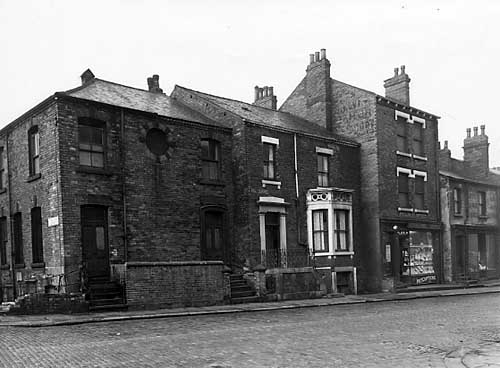
(The building on the left is located at the junction of Exmouth Street and Camp Road and was used as a synagogue in the 1930s; it is therefore likely to be the first venue of the Leeds Film Group. Undated photograph from the 1950s. West Yorkshire Archive Service, Leeds, LC/ENG/CP/27/1, no. 42)
From Baron’s writings, it is clear that these screenings were undertaken with a considerable degree of care. “We had great reverence for the films we showed,” he recalls. The Group constructed a homemade screen, decorated the space with film memorabilia, carefully selected and played musical accompaniment for the films, and prepared introductory talks. Their work was meticulously organised, with each member having an assigned role within the group: “two on projection; two on music; two on screen erection, masking out, and room decoration; two on front-of-house and membership.” Reflecting on these early screenings, Baron writes:
"We sold out every performance - even standing-room on some occasions - somewhere between sixty and eighty people per show. The audience was 70% Jewish. Many may have come because it was a Sunday night and there wasn’t much to do on Sunday nights, but they were amazingly enthusiastic and clearly impressed by what I look back on now as the sheer professionalism of the presentations."
The films shown at this primary venue reflected the Group’s ambitious programming. They screened The Cabinet of Dr Caligari, Fritz Lang’s Metropolis and both parts of Die Nibelungen, alongside works by E.A. Dupont, René Clair and Viktor Tourjansky, and several produced by Erich Pommer. This selection of French, German and Russian silent films from the 1920s closely aligned with the canon outlined in Rotha’s The Film Till Now. In practice, their choices were also shaped by availability. The programme would have been put together from what could be accessed on 9.5mm through Pathéscope. While Baron dates the Group’s formation to 1930, the exact timing of this first season is unclear, though it likely took place between 1930 and 1932.
After a successful first season, the Leeds Film Group relocated to a larger space at the Herzl-Moser Institute on 17 Brunswick Street, which seated around 100 people (the street no longer exists; the site is now home to the North Crescent flats). Having exhausted the Pathéscope 9.5mm films of interest and facing a shortage of suitable 16mm films, the group made the ambitious move to 35mm, purchasing second-hand projectors from a local cinema, the Miners Institute on York Road. This upgrade brought new challenges, requiring them to comply with safety regulations due to the highly flammable nitrate film stock. Unable to house the projector in the mandated fire-proof metal or teak box, the Group’s inventive solution was to position the projectors outside the building under a tarpaulin, projecting films through a slot in the window at the rear of the room.
Baron describes their second season as another sold-out success. The programme included the UFA-produced German silents At the Edge of the World and The Wonderful Lies of Nina Petrova, along with Fritz Lang’s The Girl in the Moon, the Soviet documentary Turksib, and the French short film Pacific 231. A small blue membership card details their ‘Summer Session 1933’ at the Brunswick Street space. The film programme is described as a ‘Syllabus’, indicating that these films were presented for study and discussion, and setting their activities apart from mere entertainment. The card advertises a screening of The Prisoner’s Song on Sunday 16th July, lists potential future titles, and mentions lectures and discussion evenings, further reinforcing their educational aims.
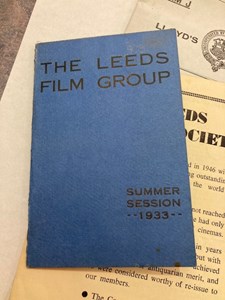
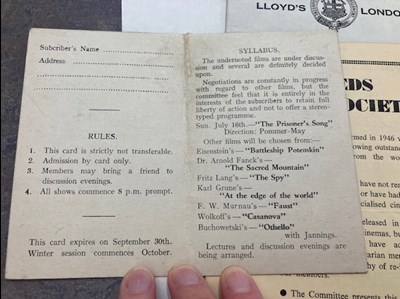
Leeds Film Group Summer Session 1933 membership card (Alec Baron Archive, University of Leeds Special Collections)
A defining feature of early independent film exhibition was its focus on screening what was often described as ‘art cinema’, later termed ‘arthouse’, ‘specialised’, and ‘cultural’ cinema. In the 1930s, a common descriptor for films shown by societies and independent exhibitors emerges: ‘unusual’. This word appeared frequently in the Baron archive, in film society and cinema ephemera. It was used to describe films that fell outside the commercial mainstream, works considered too risky, too experimental, or too limited in appeal for regular cinema programming. Typically, these were the European films championed by the film society movement: German, French and Russian productions that prioritised form and artistic ambition over box office profit. With aims similar to those of The Film Society London, the Leeds Film Group sought to create a home for such ‘unusual’ and alternative films that commercial cinemas overlooked or rejected. An article in the Yorkshire Evening Post from
July 1933, tellingly titled ‘Unusual Films May Pay’ with the subheading ‘Films For the Few’, captures the society’s ambitions as well as the perceived marginality of such programming. Reporting on a forthcoming screening, the article notes:
Karl Grune's thought-provoking production ‘At the Edge of the World’, which was crowded out of the commercial cinemas because it was regarded as a doubtful ‘box office proposition’, is to be presented by the Leeds Film Group at their private theatre 17. Brunswick Street, Leeds, tomorrow (Sunday) night at eight o'clock.
The writer goes on to lament that “this crowding out of unusual films tends to a monotony in cinema entertainment which is more pronounced at the present time than in silent film days”, suggesting that there was an appetite for alternatives to mainstream programming (YEP 29 July 1933).
In an article from the Yorkshire Evening Post the following month, it was reported that:
The Film Group at present are concentrating on preparations for an extensive and ambitious winter season. They are in negotiation for a fully equipped private theatre of much larger dimensions than the one in use now. The season will extend from October till March (YEP 26 August 1933).
The theatre in question was the Academy Cinema on Boar Lane (formerly the Savoy). With their membership ever-expanding and not wanting to turn new members away, the Group decided to move away from makeshift non-cinema spaces and into a more traditional exhibition space, approaching a local cinema to host their members-only Sunday screenings. They planned to open their winter season with a screening of Waxworks, with orchestra accompaniment, and using a print they had remarkably recovered from a London junk merchant.
The Academy Cinema in Leeds opened in September 1933 as a branch of the well-known repertory cinema, the Academy in London, an association that the Leeds Film Group helped establish. Earlier that summer, the Yorkshire Evening Post had already noted this emerging relationship, with an article announcing:
A band of earnest students of screencraft have formed a society to be known as the Leeds Film Group, and they aspire to work in harmonious connection with the Academy Cinema. Oxford Street. London, which is acting as the centre of the repertory cinema movement in England (YEP, 01 July 1933).
This press coverage was based on a Film Group press release preserved in the Baron archive and offers further insight into their ambitions. These included screening silent and sound classics that would otherwise not be seen and forming “a strong nucleus of appreciative followers.” From this nucleus, they aimed to develop an active film society, with the goal of operating from their own private theatre someday.
The ambitious winter season planned for the Academy never took place. Despite careful preparations, the Group was denied permission by the local authorities at the behest of the Cinematograph Exhibitors Association. Baron writes:
"We had received necessary permission from the Watch Committee, but the Cinematograph Exhibitors’ Association feared competition from these new ‘Film Societies’ (as they still do) and went into the attack on the grounds that this was the thin edge of the wedge to Sunday opening, which they at that time opposed."
This conflict reflects the broader resistance to Sunday cinema in Leeds at the time. Restrictions on Sunday cinema openings had been introduced following the Cinematograph Act of 1909. This legislation was aimed at regulating cinema safety, but also gave local authorities the power to decide which days cinemas could open. Consequently, many prohibited Sunday screenings on moral and religious grounds, upholding the Sunday Observance Act of 1780. Enforcing this legislation were local Watch Committees, which were powerful bodies composed of local councillors. Although ostensibly set up to oversee the police force, they in practice managed a variety of activities, including granting cinema licences, and thus acted as moral gatekeepers, dictating not only when cinemas could open, but which films were screened in their districts.
In this instance, the Leeds Film Group had approval from local authorities but faced opposition from fellow exhibitors. After the Watch Committee initially granted permission for private Sunday screenings at the Academy, the local branch of the Cinematograph Exhibitors Association (CEA) lodged a protest. Established in 1912, the CEA was a national organisation representing cinema owners' interests, and they opposed the screenings for several reasons. They argued that there was not enough demand for such performances and believed the Group would use the cinema to show uncensored films. As one of the CEA complained, “if uncensored German and Russian films were going to be shown to the members of this organisation, as seemed probable, it was extremely unfair to the ordinary cinematograph licence holder” (Leeds Mercury 02 Dec 1933). In response, a ‘Leeds Film Grouper’ wrote in the Leeds Mercury:
The Film Group intended to show films which would never be shown in the commercial cinema—not because, as one exhibitor rather stupidly suggested, they are uncensored, but because they are artistic films with a strictly limited appeal. No commercial cinema owner would dare to risk his receipts by showing them (Leeds Mercury, 06 Dec 1933).
This exchange reveals a deeper tension. For the CEA, the Film Group posed a potential threat, both economically and to exhibition traditions. Baron believed the CEA saw the Leeds Film Group as competition and misunderstood and disapproved of their hosting screenings when other cinemas were closed, regardless of the Group’s private membership.
Despite strong support from the local press, the Leeds Film Group went on hiatus after two successful seasons. This was by no means the end of their activities and marked the first of many iterations and identities. With the opening of the Academy on Boar Lane, enthusiasts of art cinema were well served, rendering a separate film society unnecessary during its years of operation. Baron, meanwhile, turned his attention to supporting the establishment of the British Film Institute by creating a pressure group called the Leeds Film Institute Society.
The next post revisits the Academy Cinema Leeds, examining the “Yorkshire Home of unusual and artistic films” and its sister venue on Oxford Street, the first dedicated art cinema in the UK.
References
Leeds Film Group Summer Session 1933 membership card, Alec Baron Archive, BC MS 20c Theatre, Baron/Box 1, University of Leeds Special Collections
Leeds Film Group letter/press release, c. 1933, Alec Baron Archive, BC MS 20c Theatre, Baron/Box 1, University of Leeds Special Collections
Untitled typed document on the history of the Leeds Film Group, Alec Baron Archive, BC MS 20c Theatre, Baron/Box 1, University of Leeds Special Collections
Alec Baron’s unpublished memoir, 1991, Alec Baron Archive, BC MS 20c Theatre, Baron/Box 13, University of Leeds Special Collections
‘The Film Public at Fault’, Yorkshire Evening Post, Saturday 01 July 1933
‘Unusual Films May Pay’, Yorkshire Evening Post, Saturday 29 July 1933
‘Harvest Time of Pictureland’, Yorkshire Evening Post, Saturday 26 August 1933
‘Sunday Cinemas Not Wanted’, Leeds Mercury, Saturday 02 December 1933
‘Sunday Films in Leeds’, Leeds Mercury, Wednesday 06 December 1933